


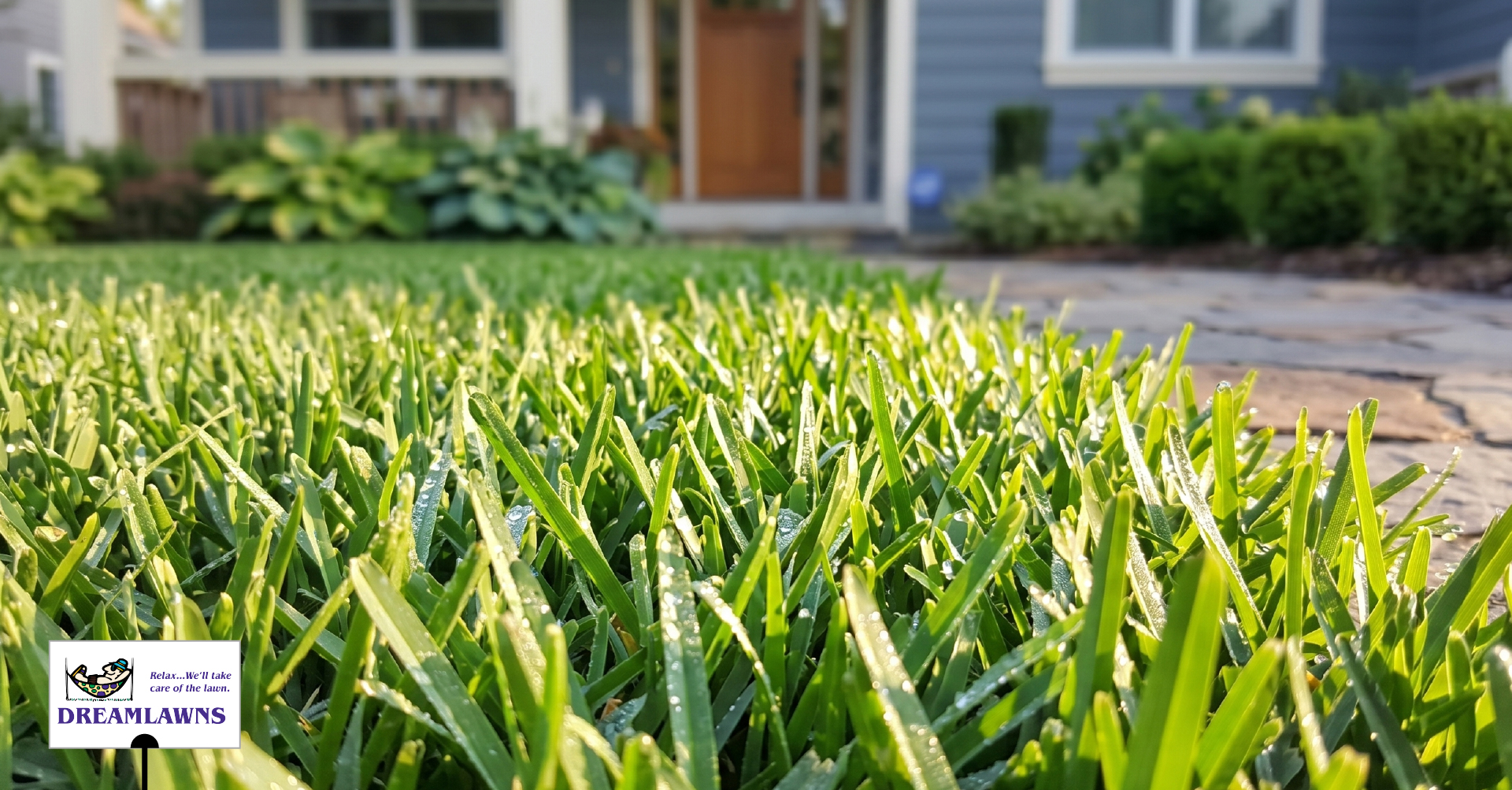
Dreamlawns Quick Cut: St. Augustine grass is one of the most difficult turf types to maintain in Virginia Beach. It tolerates shade better than Bermuda or Zoysia and spreads aggressively enough to fill in bare spots on its own, but those strengths come with serious tradeoffs. St. Augustine faces summer diseases, winter diseases, chinch bugs and other turf-damaging insects, untreatable viral pathogens, and a real risk of winterkill during hard freezes, the only common turf in Hampton Roads that regularly dies off in winter. This guide covers what St. Augustine homeowners in Virginia Beach need to know to manage it through every season.
St. Augustine grass behaves very differently from the Tall Fescue that most Virginia Beach homeowners are familiar with. It’s a warm-season grass that goes dormant in winter and spreads aggressively via above-ground runners called stolons. It handles heat and humidity better than cold, which is why summer is its strongest season in Virginia Beach, even if the region sits at the edge of where St. Augustine can reliably grow. For most properties here, St. Augustine isn’t the right choice. Its main use case is shady lots that lack the irrigation needed to support Tall Fescue, where few other turf types will establish well.
St. Augustine also has specific needs and specific failure points that generic lawn care advice doesn’t address. It’s more sensitive to cold than most homeowners realize. It has a pest, the chinch bug, that attacks it and almost nothing else. And its fertilization and weed control windows are essentially the opposite of what Fescue requires. Managing it well means understanding how it actually grows, not just what it looks like when it’s healthy.
This guide covers what you need to know about St. Augustine grass in Virginia Beach, from how it works to what it needs in every season. If you already have an established St. Augustine lawn, this is your reference for managing it well through the challenges Hampton Roads presents.
What Is St. Augustine Grass and Where Does It Fit in Virginia Beach?
St. Augustine grass (Stenotaphrum secundatum) is a coarse-textured, warm-season grass native to coastal regions of the Gulf of Mexico and the Caribbean. It’s the dominant lawn grass across Florida, the Gulf Coast, and the coastal Southeast. Most sources place Virginia Beach outside St. Augustine’s reliable growing range, and Hampton Roads winters bear that out. Coastal Virginia is the northernmost part of the state where St. Augustine has any real chance, but even here it sits at the edge of where it can survive, which shapes how you have to manage it.
A few characteristics explain why St. Augustine ends up on some Virginia Beach properties despite its challenges. Certain cultivars offer shade tolerance that’s unusual for a warm-season grass, making it an option under tree canopies where Bermuda and Zoysia struggle. Its stoloniferous growth habit means it can repair itself, filling in bare spots and recovering from damage without the annual overseeding Fescue requires. And it tolerates sandy, well-draining coastal soils reasonably well, which matches the soil conditions common across Hampton Roads. These traits don’t make St. Augustine a strong fit for the region overall, but they explain why it shows up on shady properties where other turf types won’t establish.
The most common varieties you’ll encounter in Virginia Beach are Floratam, Palmetto, and Raleigh. Floratam is vigorous and heat-tolerant but less cold-hardy, which is a significant liability in Hampton Roads. Palmetto is more compact, more shade-tolerant, and handles cooler temperatures better, making it the more resilient choice for this area. Raleigh shows up on older lawns and offers moderate cold tolerance. For properties with heavy shade, Sola may outperform Palmetto. New St. Augustine installations are rare in Virginia Beach because few sod contractors in the region work with it, and given the turf’s challenges here, we don’t recommend establishing new St. Augustine lawns. This information is most useful for identifying and managing the cultivar you already have.
Should You Install St. Augustine in Virginia Beach?
For most homeowners, the answer is no. St. Augustine sits at the edge of its survivable range in Hampton Roads and faces pressure from winter injury, summer diseases, winter diseases, chinch bugs, and untreatable viral pathogens that no other common turf type in the region has to contend with at the same scale. Significant damage isn’t a matter of if, but when, and recovery options are limited once it occurs.
The narrow exception is shaded properties without the irrigation needed to support Tall Fescue, where few other turf types will establish. In those situations, St. Augustine may be the best available option despite its drawbacks. For nearly every other property, Tall Fescue, Bermuda, or Zoysia will deliver better long-term results with less risk.
This guide is written for homeowners who already have an established St. Augustine lawn and want to manage it as well as possible through the challenges Hampton Roads presents. If you’re weighing a new installation or considering a turf transition, the better starting point is a property assessment to identify which grass type actually fits your conditions.
What Are the Biggest Challenges of Growing St. Augustine in Virginia Beach?
St. Augustine has vulnerabilities that are specific enough to be worth understanding before problems develop. These are the issues that most commonly derail St. Augustine lawns in the Virginia Beach area.
- Cold sensitivity and winterkill: Hampton Roads winters push St. Augustine to its limits. Hard freeze events can cause significant damage, particularly to Floratam, and extended periods below 20°F can kill stolons and crowns outright. St. Augustine is the only common turf type in Virginia Beach that routinely winterkills, and it’s a risk that Bermuda, Zoysia, and Fescue homeowners don’t face to the same degree.
- Chinch bugs: Southern chinch bugs are the most damaging and St. Augustine-specific pest threat in this area. They feed on the grass’s stolons, injecting a toxin that causes yellowing and death of turf easily mistaken for drought stress. By the time the damage is obvious, populations are often already large.
- Spittlebugs: Spittlebugs aren’t exclusive to St. Augustine, but they feed heavily on it and can cause significant damage during warm, humid stretches. Their telltale white foamy masses on grass blades are usually the first sign of activity.
- Summer diseases: Gray leaf spot is the most destructive summer disease in St. Augustine, spreading rapidly during hot, humid weather and often flaring after overwatering or heavy nitrogen applications. St. Augustine is also susceptible to the same warm-season disease pressure that threatens Fescue.
- Winter diseases: Large patch, spring dead spot, and take-all patch all target warm-season turf during cool, wet periods. St. Augustine faces pressure from all three, which is unusual. Most warm-season turf types are only vulnerable to a subset of these diseases.
- Viral pathogens: St. Augustine is uniquely vulnerable to several untreatable viruses, including St. Augustine Decline (SAD), Sugarcane Mosaic Virus, and Lethal Viral Necrosis. In some cases, we can support the turf with fertilizer and help it recover, but often it will at least result in significant loss, and recovery may take years.
- Thatch buildup: St. Augustine’s dense stolon network produces thatch faster than most grasses. A thatch layer that becomes too thick blocks water, fertilizer, and air from reaching the root zone and creates habitat for pests and disease.
- Herbicide sensitivity: St. Augustine is more sensitive to herbicides than warm-season alternatives like Bermuda. Many common post-emergent products can damage or kill it, so weed control requires careful product selection and timing.
What Is the Right Mowing Height for St. Augustine Grass?
St. Augustine is often mowed too short, which is one of the fastest ways to weaken an already-vulnerable turf. For existing St. Augustine lawns in Virginia Beach, the target mowing height is 3.5 to 4 inches. Palmetto and any St. Augustine growing in shadier conditions should stay on the higher end of that range. The extra blade length improves photosynthesis in low-light conditions and helps the grass compete against weeds by shading the soil.
Why Height Matters More Than Most Homeowners Think
St. Augustine’s stolons run above the soil surface, which means scalping doesn’t just stress the plant the way it does in bunch-type grasses. It physically damages the runners that drive lateral spread and recovery. A scalped St. Augustine lawn loses its ability to fill in bare spots, becomes immediately more vulnerable to chinch bug damage, and takes significantly longer to recover from any additional stress. Never mow below 3 inches under any circumstances.
The One-Third Rule
The one-third rule applies to St. Augustine just as it does to any grass: never remove more than one-third of the blade height in a single mow. If the lawn has grown to 6 inches during a rainy stretch, bring it back to 4 inches rather than cutting it short in one pass. Removing too much blade at once stresses the plant and depletes the carbohydrate reserves that fuel stolon growth and recovery.
Mowing Frequency and Timing
During peak summer growth from June through August, St. Augustine may need mowing every five to seven days to stay within the one-third rule at a 4-inch target. As temperatures cool in fall and growth slows, frequency drops naturally.
Mowing doesn’t fully stop in winter, even though St. Augustine goes dormant. Hampton Roads winters are unpredictable, with cold snaps in the teens followed by stretches of 60-degree weather that can pull the turf into semi-dormancy and spur small amounts of growth. Periodic winter mowing during these warm spells helps in a few ways. It prevents the canopy from crossing and matting down, which reduces disease pressure heading into spring. And it keeps any winter weeds at a height where they remain responsive to post-emergent herbicide applications. A lawn that hasn’t been mowed through winter typically sees significantly worse weed control results, because mature, seeded weeds stop moving fluids through their vascular system and don’t take up herbicide effectively. Frequency will be much lower than in summer, but skipping mowing entirely from December through March creates problems that show up in spring.
Blade Sharpness
St. Augustine has a broad, flat blade that is particularly susceptible to tearing from a dull mower. Torn blades have a ragged, whitish appearance after mowing and are more vulnerable to disease entry, particularly gray leaf spot. Sharpen your blade at least twice per season if you’re mowing regularly through a full Virginia Beach summer.
Clippings
Return clippings to the lawn rather than bagging them. This returns nutrients to the soil and helps moderate thatch by keeping the organic matter cycle in balance. Only bag clippings if they’re clumping visibly on the surface, which typically means you’ve let the lawn grow too long between mows.
How Should You Water St. Augustine Grass in Virginia Beach?
Watering guidance for St. Augustine in Virginia Beach is counterintuitive for homeowners used to Fescue. For established St. Augustine lawns, the default answer is: don’t water. The turf handles Virginia Beach’s rainfall patterns without supplemental irrigation in most years, and routine watering often creates more problems than it solves, including gray leaf spot, Pythium, chinch bug pressure, and accelerated thatch.
When Watering Is Appropriate
- Newly installed sod or plugs need consistent moisture until they’re established. Follow the installer’s watering schedule until the turf has rooted in.
- Prolonged drought may warrant supplemental watering at a frequency of once or twice per month, not per week.
- Wait for the turf to show the beginnings of drought stress before watering. Stressed turf begins producing abscisic acid (ABA), a root growth hormone. Watering deeply after ABA production has started encourages the hormone-charged roots to chase the water and grow deeper, which strengthens the lawn’s drought tolerance over time.
How to Water When It’s Needed
- Water deeply rather than lightly. Shallow watering defeats the purpose and keeps roots near the surface.
- Water early in the morning, ideally between 5 a.m. and 9 a.m., to reduce evaporation and minimize disease risk.
- Skip winter watering entirely. Once St. Augustine goes dormant, Virginia Beach winter rainfall is more than enough, and running irrigation through winter creates conditions for disease and root stress that surface in spring.
Signs to Watch For
- Blades folding lengthwise or taking on a blue-gray tint: early drought stress, the ABA response is starting. If drought continues, a deep watering at this point is appropriate.
- Footprints remaining visible after walking the lawn: the turf is drought-stressed.
- Soft, spongy feel underfoot: overwatering is occurring, back off immediately.
- Fungal patches or gray lesions on blades: stop watering in the evening, switch to morning only, and reduce frequency.
- Isolated yellowing that doesn’t respond to watering: rule out chinch bugs before increasing irrigation. Overwatering a chinch bug infestation accelerates the damage.
What Does a St. Augustine Fertilization Schedule Look Like in Virginia Beach?
St. Augustine’s fertilization calendar is essentially the inverse of Fescue’s. Because it’s a warm-season grass, it grows actively in summer and goes dormant in winter. Feeding it during the growing season and holding off as it approaches dormancy is what a properly timed fertilization program looks like for this grass in Virginia Beach.
When to Start: Late Spring Green-Up
Hold off on nitrogen applications until St. Augustine has fully greened up from winter dormancy and nighttime temperatures are consistently above 55°F. In Virginia Beach, that typically means late April to early May, depending on the year. Nitrogen applied too early, before the grass is actively growing, pushes tender growth that is vulnerable to late frost and disease. Other inputs, including potassium and soil-test-driven micronutrients, can still be part of early-season management to support recovery from dormancy. Wait until the lawn tells you it’s ready for nitrogen by growing consistently on its own.
The Summer Fertilization Window
Once active growth is established, fertilize on a six to eight-week schedule through the summer months. The primary nutrient St. Augustine needs is nitrogen to support stolon growth and dense turf. A balanced fertilizer with a moderate nitrogen rate applied consistently through the growing season keeps the lawn healthy without pushing the excessive top growth that creates disease pressure.
Iron applications are a valuable tool for St. Augustine homeowners who want a deep green color without adding more nitrogen. Iron supplements improve color without stimulating the rapid growth that can contribute to thatch buildup and disease susceptibility in summer.
When to Stop: Mid-September
Stop nitrogen applications on St. Augustine by mid-September at the latest. Nitrogen applied too late into fall promotes soft, lush growth that has no time to harden before cooler temperatures arrive. That tender growth is more vulnerable to cold damage and to large patch disease, which emerges as temperatures drop in fall. Other nutrients still have a role during this window. Potassium is particularly important going into fall because it strengthens cell walls, improves cold tolerance, and reduces disease pressure. Depending on soil test results, phosphorus, silica, and targeted micronutrients may also be appropriate. The goal is to stop pushing growth while continuing to support the plant’s ability to survive winter.
What to Avoid
- High phosphorus fertilizers unless a soil test shows a deficiency. Virginia Beach soils often have adequate phosphorus, and excess applications contribute to environmental runoff
- Fertilizing during drought stress or disease outbreaks. A stressed or diseased lawn cannot use nutrients effectively, and the application can make existing problems worse
- Any nitrogen applications after mid-September. The risk to cold hardiness and disease susceptibility is not worth the cosmetic benefit
Does St. Augustine Grass Need Aeration?
Yes, but the timing and approach are different from Fescue. St. Augustine’s aggressive growth habit means it produces thatch faster than most grasses. A healthy thatch layer of about half an inch is fine and actually protective. But when thatch exceeds an inch, it begins blocking water, fertilizer, and oxygen from reaching the root zone, weakening the lawn and creating ideal conditions for pests and disease.
Timing: Late Spring to Early Summer
Aerate St. Augustine only when it is fully green and actively growing, typically late May through June in Virginia Beach. This is the opposite of the fall window used for Fescue. Aerating during dormancy or the spring transition period stresses the grass at a vulnerable moment and delays recovery. Aerating during active growth gives the lawn the best ability to heal the disruption quickly and take advantage of the improved soil conditions.
Core Aeration vs. Dethatching
If thatch depth is under about an inch, core aeration alone is usually sufficient. The aeration plugs break down on the surface and introduce soil microbes that help decompose thatch naturally over time. If thatch has built up to an inch or more, mechanical dethatching may be needed before or alongside aeration. Dethatching is more aggressive and should only be done when the grass is actively growing and can recover within a few weeks. An evaluation of the thatch depth before deciding on treatment prevents unnecessary stress.
St. Augustine Does Not Get Overseeded
Unlike Fescue, St. Augustine is not overseeded annually. Its stolon-based spread means it fills in bare spots on its own when conditions are right. For larger bare areas that won’t fill in from surrounding turf, repair requires sod or plugs rather than seed, since St. Augustine isn’t grown from seed commercially. That said, extensive repair needs are often a signal worth paying attention to. If a St. Augustine lawn is losing ground faster than it can recover, it may be time to evaluate whether the turf is the right long-term fit for the property, or whether transitioning to a better-suited grass type would serve the lawn better in Hampton Roads.
What Weeds Are Most Problematic in St. Augustine Lawns?
A dense, healthy St. Augustine lawn is one of the best natural weed suppressors available in Virginia Beach. Its aggressive stolon network covers soil quickly and shades out many weed seedlings before they can establish. But during winter dormancy and in thin or stressed areas during the growing season, weeds find their opening.
Winter Annual Weeds During Dormancy
When St. Augustine goes dormant and turns brown, winter annual weeds like chickweed, henbit, and annual bluegrass have a clear path. The turf can’t compete when it’s dormant, so prevention is the only effective strategy. A properly timed pre-emergent application in October through early November, before winter weed seeds germinate, is the most important weed control step for St. Augustine homeowners in Virginia Beach.
Crabgrass in Spring
Crabgrass germinates when soil temperatures at a 2-inch depth consistently reach around 55°F, typically between mid-March and mid-April in Virginia Beach. A spring pre-emergent application timed to soil temperature rather than calendar date is the primary defense. The complication for St. Augustine homeowners is making sure the pre-emergent product selected is safe for St. Augustine at the labeled rate, as some formulations can cause temporary discoloration or stress.
Nutsedge in Summer
Nutsedge is one of the more difficult summer weeds to manage in St. Augustine because it thrives in the same warm, moist conditions the grass prefers. It’s identifiable by its triangular stem and lighter green color that stands above the lawn canopy. Selective post-emergent treatments for nutsedge are available that are safe for St. Augustine, but multiple applications are typically needed and timing matters.
Herbicide Sensitivity
St. Augustine is more sensitive to herbicides than Bermuda or Zoysia. Products containing 2,4-D at high rates can cause significant damage. Atrazine is commonly referenced in St. Augustine weed control guidance, and it’s available to homeowners in retail products like Scotts Bonus S, which combines atrazine with fertilizer. Despite its availability, atrazine is an endocrine disruptor linked to reproductive health issues, and it leaches readily into groundwater. Dreamlawns does not apply atrazine and recommends homeowners avoid it as well. Post-emergent weed control in St. Augustine lawns should always involve careful product selection based on what’s being targeted, the condition of the turf, and current weather conditions. This is an area where professional guidance significantly reduces the risk of unintended damage, both to the turf and to the surrounding environment.
What Pests Threaten St. Augustine Grass in Virginia Beach?
Pest management is particularly important for St. Augustine homeowners because the primary threat, the chinch bug, is specific to this grass and causes damage that is regularly misidentified as drought stress. By the time the correct diagnosis is made, populations can be large enough to cause widespread damage.
Chinch Bugs: The Primary Threat
Southern chinch bugs are small insects that feed on St. Augustine’s stolons by inserting a feeding tube and extracting plant fluids while injecting a toxin that disrupts water movement in the plant. The result is irregular yellowing and browning that starts in hot, sunny areas of the lawn and spreads outward. Because the symptoms look almost identical to drought stress, many homeowners respond by watering more, which does nothing to stop the damage and can make conditions more favorable for the bugs.
Chinch bug populations build rapidly in hot, dry conditions from June through August. A lawn under moisture stress is significantly more vulnerable than a well-watered one, but overwatering is not the answer. The right response is an accurate diagnosis followed by targeted insecticide treatment.
How to Check for Chinch Bugs
The coffee can method is a simple and reliable diagnostic. Remove both ends of a metal coffee can and press one end several inches into the soil at the edge of a yellowing area. Fill the can with water and watch for 10 minutes. Chinch bugs will float to the surface if present. Finding several bugs confirms an active infestation. Finding none in a drought-stressed area points toward water management as the issue rather than insects.
Other Pests
- Grubs: Grubs feed on roots below the soil surface and can damage St. Augustine lawns, particularly in late summer. Signs include turf that lifts easily, like loose carpet, and birds probing the lawn. Grub treatment timing is critical and should target young larvae before they mature.
- Sod Webworms: Surface feeders that chew grass blades from the tips down. Damage appears as irregular brown patches and is most common in late summer. Look for small green pellets of frass at the soil surface and moths flying low over the lawn at dusk as signs of an active infestation.
- For a full breakdown of how to distinguish pest damage from disease and drought stress, see our guide on why your lawn is turning brown.
What Diseases Affect St. Augustine Grass in Virginia Beach?
Virginia Beach’s summer climate creates near-ideal conditions for several fungal diseases that target St. Augustine. Most are driven by heat, humidity, and excess moisture at the turf surface. A proactive disease management approach that addresses conditions before symptoms appear is significantly more effective than reacting after damage is visible.
Gray Leaf Spot
Gray leaf spot is the most damaging disease for St. Augustine in Virginia Beach. It’s caused by the fungus Pyricularia grisea and thrives during hot, humid weather when temperatures are consistently above 80°F. It appears initially as small water-soaked spots on individual blades that quickly develop into tan or gray lesions with brown or purple borders. Under ideal conditions for the fungus, it can spread across large areas of turf within days.
Gray leaf spot is strongly associated with overwatering, evening watering, and excessive nitrogen fertilization in summer, all of which create the lush, moist surface conditions the fungus needs to spread. Correcting these practices and applying fungicide at the first sign of infection are the most effective responses. Preventive fungicide applications during the high-risk July and August window significantly reduce outbreak risk on lawns with a history of the disease.
Large Patch
Large patch is the warm-season equivalent of brown patch in cool-season grasses. It’s caused by Rhizoctonia solani and appears at the seasonal transitions in fall and spring when soil temperatures drop below 70°F. It creates large, roughly circular patches of yellow and orange-brown turf that can expand to several feet in diameter. The outer edge of the patch is often the most active zone of infection. Large patch is not typically active during the heat of summer but can return at the same spots year after year if not treated preventively.
Pythium Blight
Pythium blight is fast-moving and particularly damaging in warm, wet conditions. It appears as greasy, water-soaked patches that quickly collapse into matted, reddish-brown areas. In Virginia Beach’s summer climate, an outbreak can damage significant areas of turf within 24 to 48 hours. Proper drainage, morning watering, and avoiding overwatering are the primary preventive measures. Active outbreaks require immediate fungicide treatment with a product effective against Pythium specifically.
Take-All Root Rot
Take-all root rot is less common than the diseases above, but serious when it occurs. It’s caused by a soil-borne fungus that attacks the root system, causing gradual yellowing, thinning, and root deterioration that can be mistaken for nutrient deficiency or drought. Unlike most fungal diseases, take-all root rot is favored by cool, wet conditions in spring and fall rather than summer heat. It’s often associated with highly alkaline soils and overwatering. Diagnosis typically requires an examination of the roots rather than just the surface symptoms.
What Does a Full-Year St. Augustine Care Calendar Look Like for Virginia Beach?
St. Augustine’s care calendar is organized around its growing season, its dormancy period, and the transitions between the two. Here’s what the lawn needs, and what it doesn’t need, month by month.
January and February: Full Dormancy
- No fertilization, no irrigation beyond drought conditions, no mowing
- Avoid foot traffic on dormant turf, particularly when frozen or saturated
- Keep the lawn clear of debris that smothers crowns and promotes disease
- Plan spring treatments: pre-emergent timing, first fertilization, and any aeration or sod repair work
March and April: Coming Out of Dormancy
- Watch for green-up and do not force early treatment before it occurs
- Apply spring pre-emergent for crabgrass when soil temperatures reach 55°F at a 2-inch depth
- Light scalp mowing of dormant growth can be appropriate in late March before green-up to remove dead material and improve light penetration to crowns, but do not scalp aggressively
- Hold fertilization until consistent green growth is visible and nighttime temps are reliably above 55°F
May and June: Active Growth Begins
- Apply the first fertilizer application once fully green, typically late April to early May
- Begin regular mowing at 3.5 to 4 inches as growth picks up
- Transition to a full deep watering schedule
- Inspect for chinch bug activity as temperatures climb, particularly in sunny border areas
- Schedule aeration for late May or June if thatch management is needed
July and August: Peak Season and Peak Risk
- Mow on a five to seven day schedule at 3.5 to 4 inches
- Water deeply in the early morning. Monitor closely for drought stress versus chinch bug damage before increasing irrigation
- Watch for gray leaf spot, particularly after rain events or in areas that stay wet overnight
- Continue fertilization on a six to eight-week schedule
- Treat chinch bug infestations promptly if confirmed. Do not mistake the damage for drought and over-irrigate
September: Transition Begins
- Apply the final fertilizer application by mid-September
- Watch for large patch as soil temperatures drop below 70°F
- Reduce mowing frequency as growth slows
- No further fertilization after mid-September, regardless of how the lawn looks
October and November: Preparing for Dormancy
- Apply fall pre-emergent for winter weed prevention in October through early November
- Scale back irrigation as temperatures drop and growth slows
- Continue mowing until growth stops, then cease for the season
- Clear leaves and debris regularly to prevent smothering crowns through winter
December: Dormant
- Irrigation off unless an extended dry period is forecast
- No mowing, no fertilization, no treatment
- Monitor for any signs of winter kill in hard freeze events and note areas for spring repair
How Does Dreamlawns Manage St. Augustine Differently?
St. Augustine requires a different program than Fescue in almost every respect: different fertilization timing, different aeration timing, different weed control strategies, and a pest monitoring approach specific to chinch bugs. A generic lawn care program built around Fescue will consistently miss the mark on a St. Augustine lawn, and vice versa.
At Dreamlawns, every St. Augustine program is built around the grass’s actual growing season rather than a fixed calendar. Pre-emergent applications are timed to soil temperature for both spring crabgrass prevention and fall-winter weed control. Nitrogen applications follow the warm-season window and stop at mid-September, while potassium and soil-test-driven nutrients support cold tolerance and disease resistance through the transition into dormancy. Disease monitoring is heightened during the July and August gray leaf spot window. And chinch bug inspections are part of every service visit during the summer months, because catching an infestation early is the difference between a targeted treatment and a significant repair.
If you’re not sure whether your lawn is St. Augustine or another grass type, or if you want to understand which grass is the right choice for your property, our guide to grass types in the Tidewater area covers the full comparison.
Contact us today to schedule a property assessment. We’ll evaluate your lawn’s current condition, confirm your grass type, and build a program designed to manage St. Augustine through the specific challenges Hampton Roads presents. For homeowners considering a long-term turf transition, we can also help evaluate whether a better-suited grass type would serve the property more reliably.
Frequently Asked Questions
Yes. St. Augustine is a warm-season grass that goes fully dormant and turns brown once temperatures drop consistently in late fall. This is normal and does not mean the lawn is dead. However, Virginia Beach sits at the edge of St. Augustine’s survivable range, and hard freeze events can cause significant damage or kill crowns and stolons outright. It’s the only common turf type in Hampton Roads that regularly winterkills. In most winters, the lawn will resume growth in spring, but homeowners should expect occasional years where significant repair is needed.
The most common causes of serious damage or death in St. Augustine lawns here are winter injury during hard freeze events, untreated disease pressure (particularly gray leaf spot in summer and large patch, spring dead spot, and take-all patch in cooler months), and chinch bug damage that often gets misdiagnosed as drought stress. Scalping from mowing too short and herbicide damage from products not labeled for St. Augustine also contribute to avoidable decline. Homeowners with St. Augustine lawns should understand that significant damage is not a question of if, but when. When it happens, the options are re-establishment or waiting for the lawn to repair itself, which can take years depending on the extent of the damage and the time of year it occurs.
Begin fertilizing after the lawn has fully greened up from winter dormancy and nighttime temperatures are consistently above 55°F, typically late April to early May in Virginia Beach. Continue on a six to eight-week schedule through the summer. Apply your final fertilization by mid-September, and apply nothing after that. Fertilizing too late into fall promotes soft growth vulnerable to cold damage and increases large patch disease risk as temperatures drop.
Lawn Care Services In The Virginia Beach Area
Dreamlawns provides superior lawn care service to Virginia Beach & Chesapeake VA residents.

