


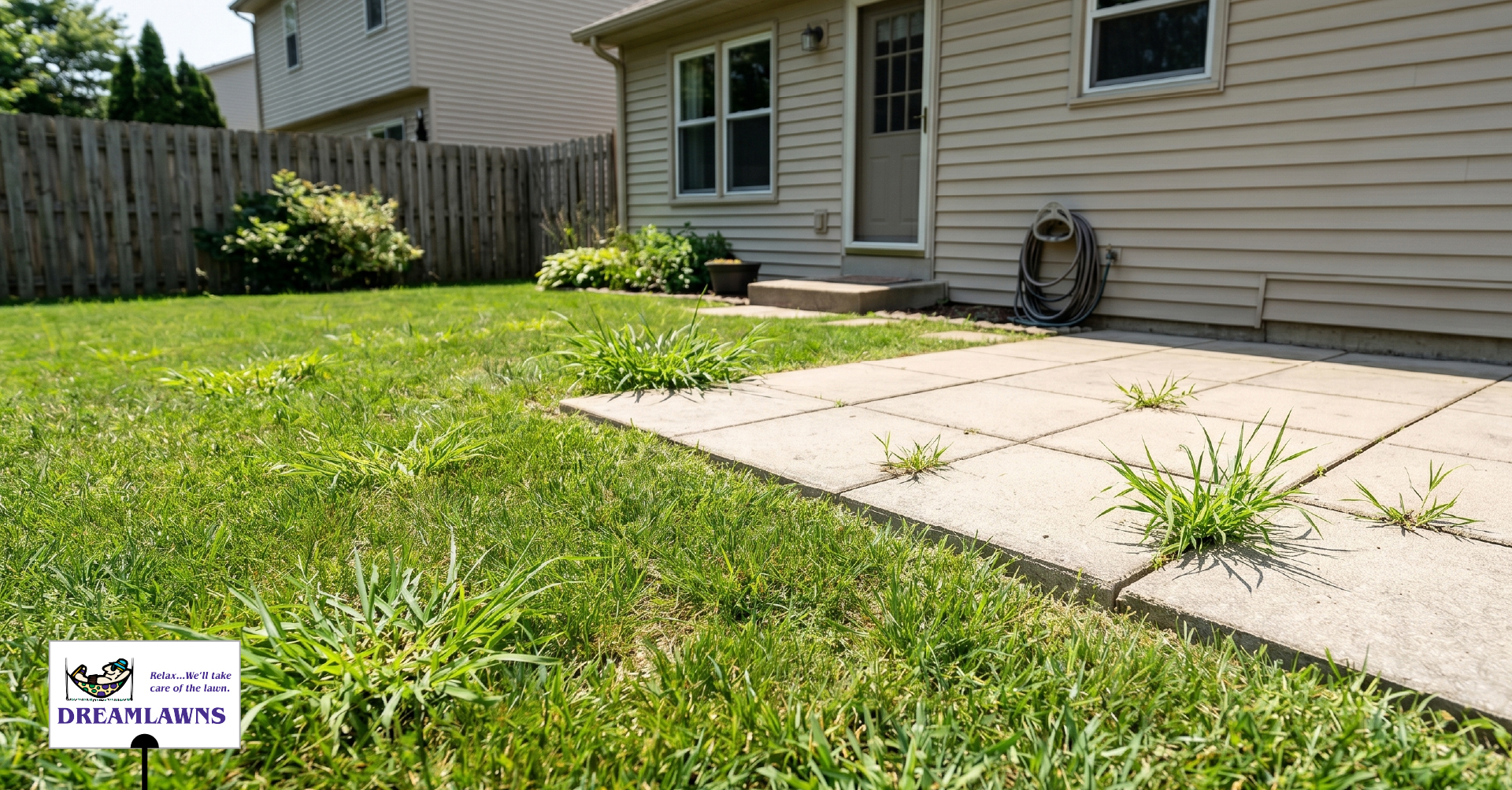
Dreamlawns Quick Cut: Crabgrass is one of the most aggressive summer weeds in Virginia Beach. It germinates in spring when soil temperatures reach about 55°F, spreads fast through thin or stressed turf, and produces thousands of seeds before dying off in fall. The most effective control is a properly timed pre-emergent application before germination, not pulling or spot-treating after it appears. Dense, healthy turf is the best long-term defense against crabgrass in Virginia Beach lawns.
Crabgrass is the weed most Virginia Beach homeowners recognize, even if they can’t name anything else growing in their lawn. It shows up in summer, spreads through thin and bare areas, and seems impossible to get rid of once it takes hold. By August, what started as a few patches can take over entire sections of an otherwise healthy lawn.
The frustrating truth about crabgrass is that by the time you see it, the window to prevent it has already closed. Crabgrass is a summer annual, which means it germinates from seed each year, grows aggressively through the warm months, produces an enormous amount of seed, and then dies off when cold weather arrives, leaving those seeds behind to repeat the cycle the following year.
Understanding how crabgrass behaves, when it germinates, how it spreads, and why timing matters far more than treatment, is the key to actually controlling it. This guide covers how to identify crabgrass, why it thrives in Virginia Beach, and the prevention and control strategies that work in this specific coastal climate.
What Is Crabgrass and How Do You Identify It?
Crabgrass is a warm-season annual grassy weed that germinates from seed in spring, grows aggressively through summer, and dies off with the first hard frost in fall. The name comes from its growth pattern: the stems radiate outward from a central point low to the ground, spreading like the legs of a crab. This sprawling habit allows a single plant to cover a surprising amount of ground while staying low enough to escape mowing.
Crabgrass is identifiable by several characteristics that distinguish it from desirable turf. It has a lighter, yellowish-green color that often stands out against darker lawn grass. Its blades are wider and coarser than most turf grasses, and it grows in a flattened, star-shaped pattern rather than upright. As it matures, it produces finger-like seed heads that spread the thousands of seeds responsible for next year’s infestation.
Two species are common in Virginia Beach: smooth crabgrass and large, or hairy, crabgrass. The differences between them matter more to specialists than to homeowners, as both respond to the same prevention and control strategies. What’s more important is distinguishing crabgrass from similar-looking perennial grassy weeds like dallisgrass, which is a different problem requiring a different approach. Crabgrass dies every winter and returns from seed. Dallisgrass is a perennial that survives winter and returns from the same root system, making it considerably harder to control.
Why Is Crabgrass So Common in Virginia Beach?
Virginia Beach provides nearly ideal conditions for crabgrass, which is part of why it’s such a persistent problem in lawns across the area. Several local factors work together to favor it.
- Hot, humid summers: Crabgrass is a warm-season weed that thrives in exactly the heat and humidity that define a Virginia Beach summer. The conditions that stress cool-season Fescue are the same conditions crabgrass loves.
- Sandy coastal soils: Although not found in all Virginia Beach lawns, sandy soils can be common throughout Hampton Roads and warm up quickly in spring, which accelerates crabgrass germination, and they create the open, well-drained conditions where crabgrass establishes easily.
- Thin turf from summer stress: Fescue lawns naturally thin during the summer from heat and disease pressure. Every thin or bare spot is an open invitation for crabgrass to fill the gap, since the weed needs sunlight reaching the soil to germinate.
- Compacted, high-traffic areas: Crabgrass tolerates compacted soil better than most turf grasses. Driveways edges, walkways, and high-traffic zones where the lawn is thin and the soil is compacted are classic crabgrass hot spots.
The common thread among all of these factors is opportunity. Crabgrass is an opportunistic weed that exploits weakness in the lawn. Where turf is thick and healthy, crabgrass struggles to establish. Where turf is thin, stressed, or compacted, it moves in aggressively. That’s why crabgrass control in Virginia Beach is as much about lawn health as it is about herbicide.
When Does Crabgrass Germinate in Virginia Beach?
This is the single most important thing to understand about controlling crabgrass, because it determines when prevention works and when it doesn’t. Crabgrass germinates when soil temperatures at a 2-inch depth consistently reach approximately 55°F. In Virginia Beach, that threshold is typically crossed somewhere between mid-March and mid-April, depending on the year’s weather.
The critical word there is soil temperature, not air temperature, and not the calendar date. A warm stretch of air temperatures in February doesn’t necessarily mean the soil has warmed enough for germination, and a cool spring can push the germination window later than usual. Relying on a fixed calendar date to time crabgrass prevention is one of the most common reasons homeowners miss the mark, applying too early when the product breaks down before germination, or too late when seeds have already sprouted.
It’s also important to understand that crabgrass doesn’t germinate all at once. Germination happens over a window of several weeks as soil temperatures rise and stabilize, and a second flush can occur later in the season. This staggered germination is why a single, perfectly timed pre-emergent application sometimes isn’t enough, and why understanding the life cycle of a weed is central to controlling it effectively.
Why Does Crabgrass Keep Coming Back Every Year?
If you’ve fought crabgrass before, you already know it returns season after season, no matter what you did the previous summer. The reason comes down to one word: seeds.
A single crabgrass plant can produce thousands of seeds before it dies off in the fall. Those seeds drop into the soil and join what’s known as the seed bank, a reservoir of dormant weed seeds waiting for the right conditions to germinate. Crabgrass seeds can remain viable in the soil for several years, which means even a single summer of uncontrolled crabgrass can seed the lawn for multiple years to come.
This is why reactive treatment alone never solves a crabgrass problem. You can pull or spot-treat every visible plant in July and still face a full infestation the following summer, because the seeds from this year’s and previous years’ plants are already in the soil. Breaking the cycle requires preventing germination in the first place and reducing the conditions that let crabgrass thrive, season after season, until the seed bank is depleted and the lawn is dense enough to keep new seeds from establishing.
How Do You Prevent Crabgrass? Pre-Emergent Timing Is Everything
The most effective crabgrass control strategy is prevention through properly timed pre-emergent herbicide. Pre-emergent works by creating a chemical barrier in the top layer of soil that stops germinating seeds from developing into established plants. It doesn’t kill existing crabgrass, and it doesn’t stop seeds from sprouting, but it prevents those sprouts from successfully taking root.
Timing to Soil Temperature
Because pre-emergent only works before germination, it must be applied before soil temperatures reach the 55°F threshold. In Virginia Beach, that generally means applying in early to mid-March, ahead of the typical germination window. Applying too late, after crabgrass has already begun germinating, renders the barrier far less effective. This is the same soil-temperature-based timing principle that applies to all the most important early spring lawn care decisions.
Split Applications Extend Protection
Because crabgrass germinates over a window rather than all at once, a single pre-emergent application can lose effectiveness before the germination period ends. A split application strategy, where a second application is made several weeks after the first, extends the protective barrier through the full germination window and significantly improves control. This is standard practice in professional programs and is one of the reasons professionally treated lawns tend to have far less crabgrass than those treated with a single store-bought application.
Watering In Is What Activates the Barrier
Pre-emergent doesn’t form its protective barrier in the soil until it’s watered in. Until that happens, the product sits on the surface and degrades from sunlight and air exposure without ever doing its job. For applications timed close to the germination window, this matters even more, since every day the barrier isn’t active is a day crabgrass seeds may be sprouting underneath. The general rule is to water in pre-emergent within 24 to 48 hours of application using about half an inch of water, either through irrigation or a measurable rainfall. For late-season or close-to-germination applications, the sooner the activation happens, the better. Skipping or delaying the watering step is one of the most common reasons a properly timed pre-emergent application still produces poor crabgrass control.
The Seeding Conflict
There’s one important caveat for Fescue homeowners. Pre-emergent prevents all seed germination, including desirable grass seed. If you’re planning to overseed a Fescue lawn, you cannot apply pre-emergent in the same window without preventing your new grass from establishing. For Fescue lawns, this is generally less of an issue in spring since the primary Fescue overseeding window is fall, but it’s a conflict that has to be planned around. Fall pre-emergent for winter weeds has the same consideration, which is covered in our guide on the hidden dangers of fall weeds.
How Do You Get Rid of Crabgrass That’s Already Growing?
If crabgrass is already established in your lawn, prevention is off the table for this season, and the options become more limited and less effective. That said, there are still steps worth taking to manage an active infestation and limit the seed it produces.
- Post-emergent herbicide: Selective post-emergent products can control crabgrass after it emerges, but they work best on young, immature plants. Once crabgrass matures and begins producing seed heads, post-emergent control becomes much harder and often requires multiple applications. Product selection also matters by grass type, since some post-emergents can damage certain turf grasses.
- Hand-pulling small infestations: For a handful of plants, hand-pulling can work, ideally before the plant produces seed. Remove the entire plant, including the root crown, and be aware that disturbing the soil can expose more weed seeds to the light they need to germinate.
- Don’t rely on spot treatment alone: Treating only the visible plants does nothing about the seed bank or the underlying conditions that let crabgrass establish. Spot treatment manages symptoms. It does not break the cycle.
The most important thing to understand about reactive crabgrass control is that it’s always a fallback, never the plan. Even successful post-emergent treatment this summer doesn’t prevent next year’s germination from the seed bank. And if the underlying conditions, such as thin turf, compacted soil, and bare areas, aren’t addressed, crabgrass will return to the same spots year after year, regardless of how aggressively you treat what you can see.
Why Is Healthy Turf the Best Crabgrass Defense?
The single most effective long-term defense against crabgrass isn’t a herbicide at all. It’s a thick, healthy lawn. Crabgrass seeds need sunlight reaching the soil surface to germinate. A dense turf canopy physically blocks that light, denying crabgrass the conditions it needs to establish in the first place.
This is why the fundamentals of good lawn care double as crabgrass prevention. The practices that keep your lawn dense and healthy are the same ones that keep crabgrass out:
- Proper mowing height: Mowing at the correct height for your grass type, which for Tall Fescue means 4 inches, shades the soil and reduces the light that reaches crabgrass seeds. Mowing too short opens the canopy and invites crabgrass in.
- Deep, infrequent watering: Watering deeply and infrequently encourages deep root growth and a strong, competitive lawn. Shallow, frequent watering produces weak turf that crabgrass exploits.
- Correct fertilization: Feeding the lawn on the right schedule for its grass type keeps it dense and vigorous. A well-fed, healthy lawn outcompetes crabgrass for space, light, and nutrients.
- Aeration to relieve compaction: Core aeration relieves the compacted soil conditions that crabgrass tolerates better than turf, helping your grass grow denser and more competitive over time.
Over time, the combination of preventing germination and building turf density depletes the seed bank and crowds out crabgrass to the point where it stops being an annual battle. That’s the goal: not just controlling this year’s crabgrass, but creating conditions where it can’t establish in the first place.
How Does Dreamlawns Control Crabgrass in Virginia Beach?
At Dreamlawns, crabgrass control is built around the same principle that drives everything we do: prevention timed correctly beats reaction every time. Our crabgrass control program starts with pre-emergent applications timed to soil temperature rather than the calendar, so the protective barrier is in place before germination begins, not after.
We use split applications where appropriate to extend protection through the full germination window, which a single store-bought application can’t match. When crabgrass does break through, we apply targeted post-emergent treatment based on your grass type and the maturity of the weed. And because we know that crabgrass thrives on weak turf, our year-round fertilization and weed control program is designed to build the dense, healthy lawn that keeps crabgrass from establishing in the first place.
This integrated approach, prevention, targeted treatment when needed, and turf health management, is what separates lasting crabgrass control from the temporary results of spot-treating what you can see. Over time, it depletes the seed bank and builds a lawn that resists crabgrass naturally.
Contact us today to schedule a property assessment. We’ll evaluate your lawn, identify the conditions feeding your crabgrass problem, and build a program that actually breaks the cycle.
Frequently Asked Questions
Apply crabgrass pre-emergent before soil temperatures at a 2-inch depth consistently reach 55°F, which in Virginia Beach typically means early to mid-March. Timing to soil temperature rather than the calendar is critical, since a warm or cool spring shifts the germination window. Applying too late, after crabgrass has started germinating, significantly reduces effectiveness. A split application extends protection through the full germination window.
Hand-pulling can help with small infestations if you remove the entire plant, ideally before it produces seed. But pulling alone doesn’t address the seed bank already in the soil or the underlying conditions that let crabgrass establish, so it rarely solves the problem long-term. Disturbing the soil while pulling can also expose more weed seeds to the light they need to germinate. For lasting control, prevention through pre-emergent and building dense turf matter more than pulling.
Crabgrass returns every summer because a single plant produces thousands of seeds that remain viable in the soil for years. Even if you control the visible crabgrass one season, the seed bank produces a new crop the next. Recurring crabgrass is also a sign of underlying conditions like thin turf, compacted soil, or bare areas that give crabgrass the open ground and sunlight it needs. Breaking the cycle requires preventing germination and building turf density over multiple seasons.
Yes. Crabgrass is a summer annual, meaning it completes its entire life cycle in one growing season and dies off with the first hard frost in fall. The problem is that before it dies, each plant has already dropped thousands of seeds into the soil that will germinate the following spring. So while the visible crabgrass disappears in winter, the infestation isn’t gone, it’s waiting in the seed bank. This is why preventing germination in spring matters far more than waiting for winter to kill the existing plants.
Lawn Care Services In The Virginia Beach Area
Dreamlawns provides superior lawn care service to Virginia Beach & Chesapeake VA residents.

